


Why Art History Matters: Guest Blog by Katy Hessel
There are many ways to tell stories. We can read them; we can hear them; we can experience them; and we can look at them. Art history is an essential subject because it invites us to see the world from an individuals’ perspective. Artworks tell us about what someone was interested in at a certain time, or how they felt. Through them, we can peer into the minds and lives of those who came before us.
Despite some art being thousands of years old, it can still tell an artist’s story. Art – like music, dance or writing – is a way of communicating about the world, and to express yourself.
Growing up, I struggled with reading and writing. Pictures became my salvation. I would be taken to museums by my older sister – because they were free! – and, together (as if we were detectives), we would decode what we saw in front of us. Eventually, all sorts of stories would appear. That is the excitement of art: look at something for 30 seconds, and entire universes emerge.
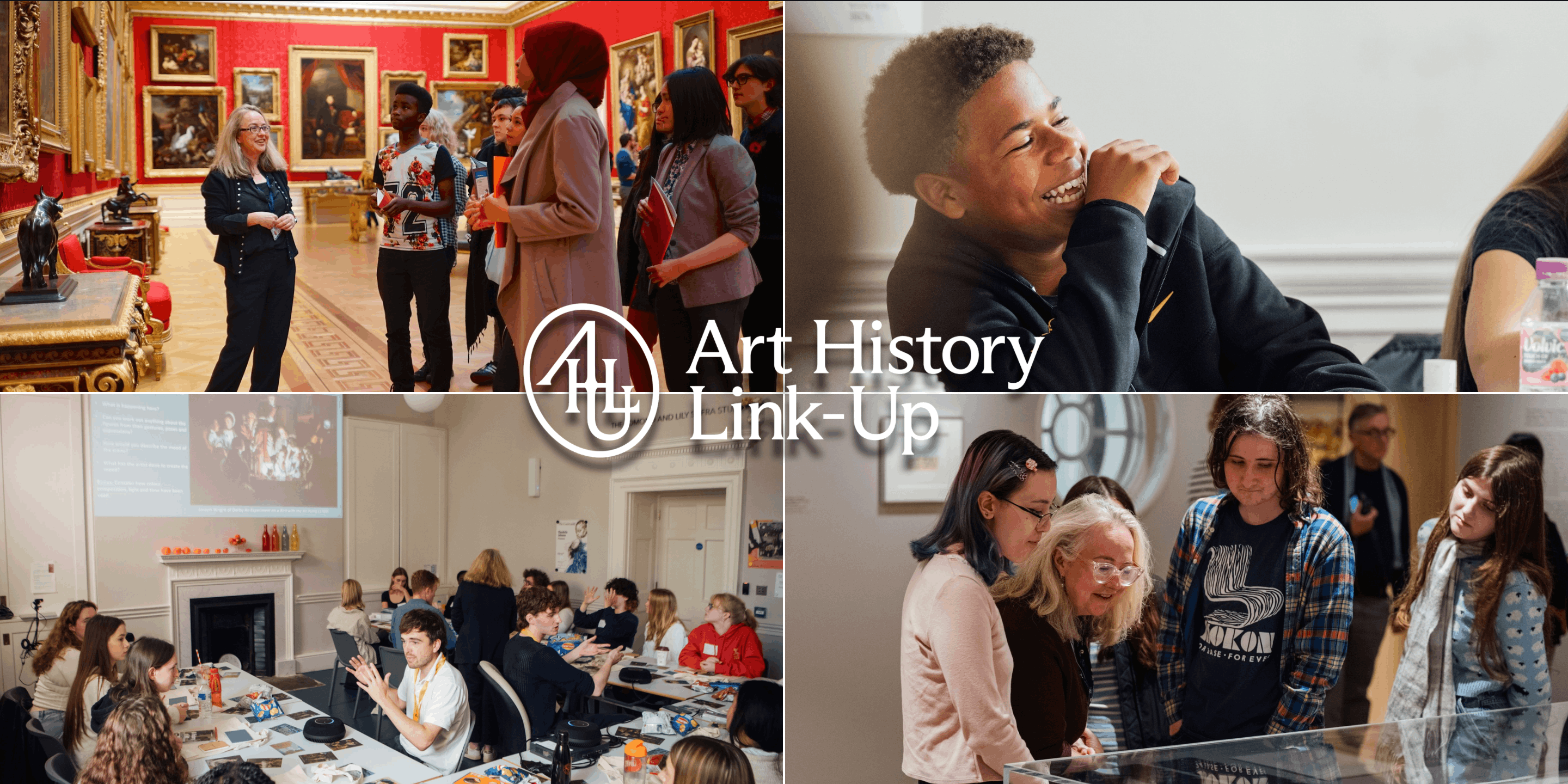
So I was thrilled to learn of the important work AHLU is doing in expanding their free Art History courses to younger secondary school students. Especially the Introduction to Art History, a course that will take place over ten Sundays, beginning this April at the Courtauld, Somerset House. Not only will it offer Y9 and 10s the opportunity to curate their own mini exhibitions, but gain an accredited award equivalent to up to half a GCSE – an opportunity I would have loved at their age.
I’ve been visiting schools to celebrate the launch of my new book The Story of Art without Men: An Illustrated Guide to Amazing Women Artists – aimed at younger readers. Often, I am taken aback by how many students, who initially don’t think ‘art is for them’, find works that speak to them in unexpected ways.
For example, if they’re interested in sport – there’s art about that. (One only has to go to the Royal Academy’s dazzling Rose Wylie exhibition to see a mid-action painting of an Arsenal vs Spurs game!) There’s also art about climate awareness and the environment, music, travel, reading, science, cinema – even gaming.
Art history is important because it can make you feel seen. We are living in an extraordinary time when finally people of all different backgrounds are being represented and celebrated on gallery walls.
When I was younger, I thought a career in art history had to ‘look’ a certain way. After finishing Art History at university, I didn’t have the option of doing a Masters. I had to get a job. So, I worked in galleries – which was an excellent education – and, in my spare time, kept up my studies by running @thegreatwomenartists on Instagram. I eventually turned it into a podcast – interviewing the likes of Tracey Emin – and, later, a book: The Story of Art without Men, which I wrote in a conversational style so everyone could access this fantastic subject.
A foundation in art history is essential for going into a host of professions or university courses, be they politics, music, art, law, communications, and more. Not only will it give you insight into the past, and the world at large, but, by giving you an understanding of who lived before us, can take you to the core of humanity; teaching you empathy, open mindedness, and the superpowers of human creativity.
There is no right or wrong way to look at an artwork – all opinions are valid and valued. It is there to be debated and discussed, which can supply us with the tools to present, as well as give us agency to have an opinion.
We need more people studying this subject so they can, too, bring their unique perspective. I applaud AHLU’s initiative in offering free accredited Art History courses for state students, at museums, galleries and online for young people from diverse backgrounds, and particularly for GCSE-level students, at who my new book is aimed at. These are life-changing opportunities: please share and apply!
Katy Hessel
Katy Hessel is an art historian and the author of the international bestseller The Story of Art without Men (Waterstones Book of the Year 2022); How To Live an Artful Life and The Story of Art without Men: An illustrated guide to amazing women artists (her first book for younger readers). She runs @thegreatwomenartists on Instagram, hosts The Great Women Artists Podcast, and writes a column for The Guardian. A Visiting Fellow at Cambridge University and Trustee of Charleston, she has presented documentaries for the BBC and launched Museums Without Men, a growing audio series highlighting works by women artists in museum collections worldwide.

Related Articles

Art History is under threat
We believe art history should be for everyone, however fewer than 1% of state supported secondary schools offer Art History A Level. As a result, there is a lack of diversity in the arts sector and an increasing skills shortage. We are the only charity offering formal Art History teaching to school-aged students from all backgrounds. Your financial support will ensure that everyone has an opportunity to study art history: together we can transform the future of the arts.
